
Q
Why Routine and Structure Are Important for Children in ABA Therapy?
Routine and structure are important in ABA therapy because they reduce uncertainty, increase learning, and lower challenging behavior. Predictable steps help children focus, repeat skills, and build habits that generalize to real life. Visuals, timers, and consistent prompts guide each session so skills grow across routines.
A
Key Points:
- ABA routines and structure use predictable steps, visuals, and consistent cues to reduce stress and improve learning.
- By organizing each activity into clear sequences with visible goals and steady reinforcement, children develop independence, emotional regulation, and confidence in daily routine
Morning rush turns messy when plans change. Children on the spectrum feel that spike more. Applied Behavior Analysis uses routine and structure to make each day predictable and teach skills in small, repeatable steps.
Below, you will see why consistent rhythms help communication, behavior, and independence, and how to set them up using simple tools you already have.
 What Do “ABA Routines and Structure” Look Like Day to Day?
ABA routines and structure in ABA therapy mean clear start and end points, visual cues, and repeatable steps. The aim is to reduce surprises and make each action teachable. Predictability lowers stress so kids can focus on the skill in front of them.
Structure does not mean rigidity. Therapists plan small variations so children learn to handle change without spiraling. The plan also sets where and when adults prompt, fade help, and celebrate effort.
Common elements you will see in an ABA therapy session:
- Warm-up: Short preferred task that earns quick success and sets momentum.
- Skill blocks: Discrete or naturalistic trials with clear cues, models, practice, and feedback.
- Movement breaks: Brief, scheduled pauses that keep energy even and prevent behavior spikes.
How this feels at home (what is in-home ABA therapy like):
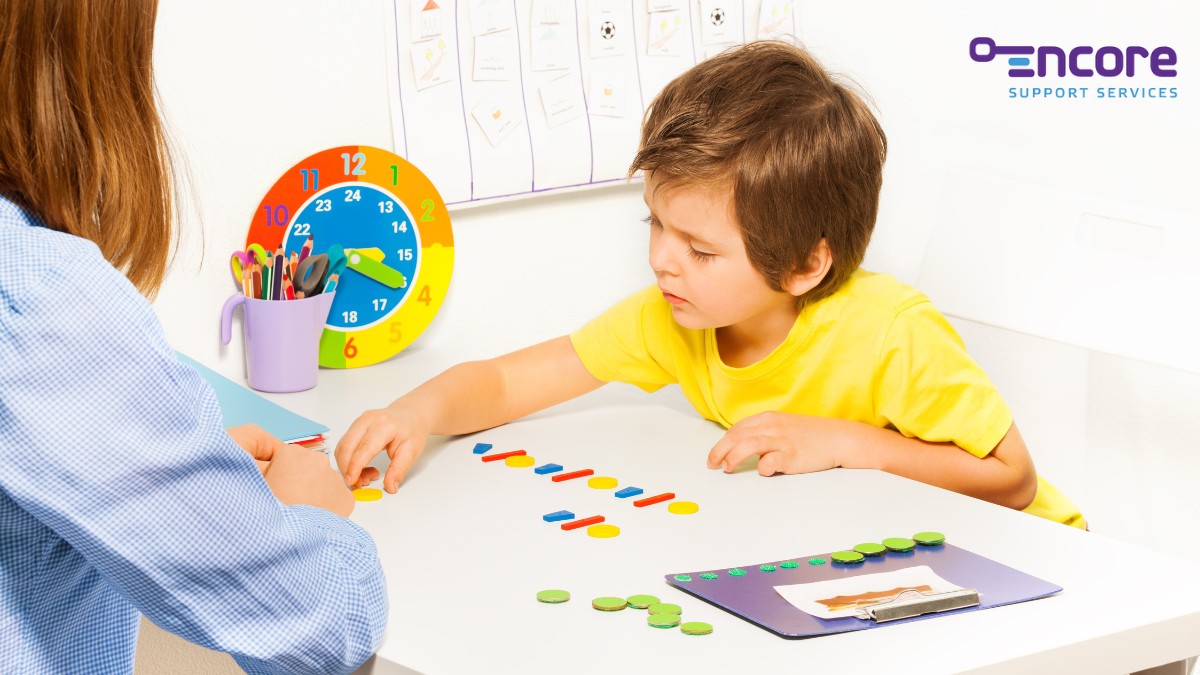
- Predictable start: A visual timer, a “first-then” card, and a consistent meeting spot.
- Functional targets: Dressing, toothbrushing, packing a bag, or requesting help.
- Wrap-up ritual: A simple summary and token exchange that marks the session end.
Why Do Routines Reduce Challenging Behavior?
Change, especially during the first ABA session, can be difficult when transitions feel unclear. Routines take the confusion out. When a child can see the steps and the reward, refusal drops and participation rises. Structure also gives adults a shared playbook so prompts, language, and rewards stay consistent.
A well-built schedule does more than prevent meltdowns. It creates a loop of cue → action → feedback that brains can repeat and strengthen. Over days, that loop becomes a habit the child can start without prompts.
Evidence in practice:
- A clinical study found problem behavior dropped 76% with visual schedules plus teaching versus 61% with teaching alone. Visuals amplified the effect by clarifying transitions.
Quick builder moves:
- Make next steps visible: Use pictures or words arranged left to right.
- Preview endings: Give a two-minute signal and point to the finish icon.
- Close the loop: End with the same short success so the last memory is positive.
How Do Routines Accelerate Skill Learning?
Learning moves faster when the environment stays predictable but the tasks progress in small jumps. ABA session structure sets clear criteria for success, then nudges the difficulty a notch at a time. The child experiences steady wins that build momentum.
Routines also free up attention. Without constant surprises, the child can practice the target skill, whether it is requesting a snack or zipping a jacket, more times in less time. Repetition with feedback builds fluency.
Skill-growth playbook (ABA session structure):
- Set one objective: Example of ABA therapy session goals might be “ask for help” across three activities.
- Slice the skill: Break into micro-steps the child can finish in under a minute.
- Track tiny wins: Use a simple tally or token board linked to a specific reward.
Visuals, Timers, and Checklists That Actually Work
Visual schedules anchor ABA routines and structure. Pictures, words, or icons show the order of activities and the expected behavior. Timers add a concrete “when.” Checklists track progress and make completion visible.
Use visuals everywhere the routine happens. A bathroom brushing strip, a bedroom dressing chart, a kitchen snack request board. Keep icons the same across rooms so meaning stays stable.
Tools that earn their keep (what is ABA scheduling):
- First–Then boards: Show the next task and the earned item.
- Countdown timers: Provide a steady cue for start, stop, and transitions.
- Task strips: Display mini-steps like “Wet brush → Add paste → Brush top teeth.
In a randomized trial of a parent-led routines program, parents improved children’s participation in daily routines and reported better engagement across home activities.
Generalization: From Session Wins to Real-Life Wins
Structure helps skills transfer because the same cues appear in new places. The breakfast checklist mirrors the therapy strip; the school “first-then” mirrors the home card. Consistency across settings lowers the load on memory and supports carryover.
Generalization also depends on varied practice. Keep the steps the same but change small details like location, materials, or person. The point is to teach the idea of the skill, not one fixed routine.
Progression ideas:
- Level 1: Change a small detail (blue cup to green cup).
- Level 2: Change the order (snack before coloring).
- Level 3: Change the setting (kitchen to school cafeteria).
 Parent Roles: The Multiplier for Consistency
When caregivers learn the same routines and prompts through parent training, therapy multiplies. Parent practice also helps therapists spot barriers that only appear at home, like sibling noise or tight mornings.
The strongest data for behavior change often involves structured parent training tied to routines. One large trial showed a 47.7% drop in irritability scores with parent training versus 31.8% with education alone, and 68.5% of children were rated responders compared with 39.6% in education.
Ways to make practice realistic:
- Pick two routines first: Morning prep and after-school snack are high-impact.
- Use the same words: Keep prompts short and consistent across adults.
- Celebrate the effort: Pair every hard step with a quick, specific praise line.
Sample Day: A Simple ABA Therapy Session Flow at Home
Structure does not require fancy tools. A kitchen table, a small bin of materials, and a timer can cover most sessions. The goal is a steady rhythm that repeats across days so children feel safe and ready to try.
Below is an example of ABA therapy session flow that many families adapt. The same idea behind evening and weekend ABA that fits real after-school energy, parent schedules, and home routines. It keeps blocks short, alternates effort with relief, and ends clearly.
Example of ABA therapy session (30–45 minutes):
- Warm-up (3 minutes): Preferred puzzle or matching to earn the first token.
- Target Block 1 (7 minutes): Requesting help across two tasks with quick rotations.
- Movement Break (2 minutes): Stretch or short walk to the door and back.
- Target Block 2 (7 minutes): Following two-step directions in a play routine.
- Generalization Burst (5 minutes): Do the same targets in a new room.
- Wrap-up (3 minutes): Token exchange and a short victory activity.
Data Without the Headache
Data confirms where routines help and where they fail. Parents who learn how to communicate with their child’s ABA therapist receive clearer updates on goals, progress, and what to adjust at home.
What you measure depends on the goal. If the goal is smoother transitions, measure the time from “timer beep” to “start next task.” If the goal is independence, measure how many steps the child completes before a prompt.
Quick metrics that guide fast tweaks (aba therapy session):
- Latency to start: Seconds between cue and first action.
- Prompt level: Independent, gesture, or model.
- Reinforcer success: Did the chosen reward maintain effort?
Pitfalls and Fixes When Structure Feels “Too Rigid”
Families sometimes worry that routines will make kids inflexible. The plan solves that by adding planned variation. Change one detail at a time while keeping the core steps. Over weeks, the child learns that small changes are safe.
Another pitfall is schedules that are too long. Keep strips short and chunk the day. A morning strip, a school strip, and an evening strip are easier to follow than a wall-length plan.
Fixes that keep balance (aba session structure):
- Start tiny: Three to five steps per strip beats fifteen steps that overwhelm.
- Blend choice: Offer two options that both meet the goal.
- Refresh rewards: Use positive reinforcement techniques and rotate motivators so interest stays high.
 Frequently Asked Questions
How do you structure an ABA session?
Structure an ABA session by beginning with an easy success, followed by two or three short skill blocks with cues, practice, and feedback. Include short movement breaks. End with a clear wrap-up and reward. Focus on one main goal, track prompt levels, and keep a consistent routine across sessions.
Why is structure and routine important in autism?
Structure and routine are important in autism because they reduce uncertainty and help focus on skills instead of surprises. Predictable steps lower behavior spikes, improve consistency across settings, and support independence. With repetition, children need fewer prompts and handle transitions and small changes with more calm and control.
What is the biggest red flag for autism?
The biggest red flag for autism is a combination of early social and communication delays, such as limited eye contact, delayed speech, and lack of response to name. Repetitive movements and distress during changes also raise concern. Multiple signs together signal the need for screening and early evaluation.
Apply ABA Routines and Structure at Home Today
Parent-led structure builds calmer transitions and real-life skills. If you are in the Northeast, consider autism therapy services in New York and New Jersey that teach you how to build simple schedules, coach consistent prompts, and measure small wins. At Encore ABA, we align home routines with therapy targets so progress shows up where it counts most.
Families start with a clear plan for two daily routines, learn how to use visuals and timers, and get weekly feedback on data. Most parents tell us they spend less time on arguments and more time on practice. Reach out to book a consult, ask about insurance, and see a sample schedule you can use this week.
Recent Questions
- Will my child ever be perceived as “normal”?
- How do I deal with an intensely emotional child, while juggling daily dut...
- How can I foster the development of early reading skills in my young childr...
- How can I help my child make friends?
- How do I make my home environment a happy, safe place for my child?
Encore Services
Special Ed
●
Behavior Modification DIR/Floortime
●
Social Skills & Social Thinking
●
Speech-Language Therapies
●
Multi-Sensory Math & Reading Instruction
●
Brain Gym & Physio-neurotherapy
●
Hebrew Reading Skill (Kriah) Training
●
Hands-On Music Therapy
●
Neuropsychological, Nutritional & Behavioral Evaluations
Encore ABA
●
Behavior Modification DIR/Floortime
●
Social Skills & Social Thinkin
g●
Speech-Language Therapies
●
Multi-Sensory Math & Reading Instruction
●
Brain Gym & Physio-neurotherapy
●
Hebrew Reading Skill (Kriah) Training
●
Hands-On Music Therapy
●
Neuropsychological, Nutritional & Behavioral Evaluations
