
Q
How Do Encore’s ABA Programs Prepare Children for Academic Success?
Encore’s ABA programs prepare children with autism for academic success by teaching communication, attention, social interaction, emotional regulation, and independence through structured, step-by-step methods. In-school collaboration with teachers ensures skills generalize to real classrooms, helping children focus, follow directions, and thrive in learning.
A
Many parents worry when school feels harder for their child than it should be. Difficulty focusing, trouble following directions, or struggling to connect with classmates can leave children feeling left out and families unsure how to help.
Encore’s ABA programs are designed to build the skills that shape success in school. By breaking learning into clear, practical steps, children gain tools they can carry into the classroom and beyond.
What follows shows how structured ABA support prepares children for learning, strengthens school participation, and helps build the confidence needed to thrive.
1. Building Communication as a Learning Foundation
Communication Skills for Autism
Clear communication is central to school success. Children with autism may struggle to express needs, answer questions, or understand group instructions. ABA programs focus on teaching both verbal and effective non verbal communication skills, such as gestures, pointing, or picture exchange.
How This Impacts the Classroom
- • Children can ask teachers for help when confused.
- • Peer connections grow when children learn how to initiate and respond to social cues.
- • Lessons become more interactive when children can share answers in their own way.
Example: A child who once screamed when frustrated may instead learn to hand a picture card to request a break. This small change reduces disruptions and keeps learning on track.
 2. Increasing Attention and Classroom Readiness
Focus and Attention Span
Many children with autism find it hard to sit still or stay focused. ABA therapists use reinforcement strategies to slowly increase how long a child can stay on task.
A study published in Scientific Reports demonstrated that sustained attention abilities strongly predict academic performance, particularly in reading and math, when measured in real classroom, group-based settings. These findings highlight why building focus through structured programs is essential for long-term academic success.
Following Directions
Teachers often use multi-step instructions: “Take out your notebook, write your name, then start the first problem.” ABA programs break these tasks into smaller steps and use prompts until the child masters them. Over time, children learn to handle increasingly complex directions, an essential part of academic growth.
3. Strengthening Social Interaction in the Classroom
Autism Support in Peer Settings
Aside from academics, school is also about learning how to work with others. Encore’s ABA programs emphasize teaching social rules like sharing, turn-taking, and respecting personal space.
In-school ABA therapy ensures these skills are practiced where they matter most, which is in the classroom itself. Children are guided to join group games, contribute to projects, and interact with peers in ways that promote inclusion.
Why Social Interaction Matters
- • Friendships protect against isolation and bullying.
- • Collaborative learning improves problem-solving.
- • Social engagement increases overall school satisfaction.
4. Teaching Emotional Regulation for School Success
Handling Transitions and Stress
Unexpected changes can trigger meltdowns: fire alarms, substitute teachers, or sudden schedule shifts. ABA therapy helps children identify emotions and practice coping strategies such as requesting a break, using breathing exercises, or following visual calm-down routines.
Connection to Academic Outcomes
Children who can regulate emotions spend less time distressed and more time learning. Teachers also find it easier to deliver lessons when emotional outbursts are reduced.
 5. Promoting Independence in Daily School Routines
Daily Classroom Routines
From hanging backpacks to lining up for recess, school days are filled with routines. ABA therapy builds independence by teaching step-by-step sequences with reinforcement until they become habits.
Self-Management Skills
Older children can learn self-monitoring strategies like using a visual checklist for assignments or a timer to stay on task. These habits prepare them for homework, long-term projects, and independent study in later school years.
6. Improving Verbal and Non Verbal Learning
Effective Non Verbal Communication Skills
Even without words, children can show understanding. ABA programs strengthen gestures, facial expressions, and pointing to ensure children can interact effectively with teachers and peers.
Expanding Verbal Communication
ABA also encourages spoken language where possible. Techniques like prompting and reinforcement help children learn to label objects, answer questions, and form short sentences. This builds academic participation, especially during reading, math, and group discussions.
7. Partnering With Teachers for Consistency
In-School ABA Therapy
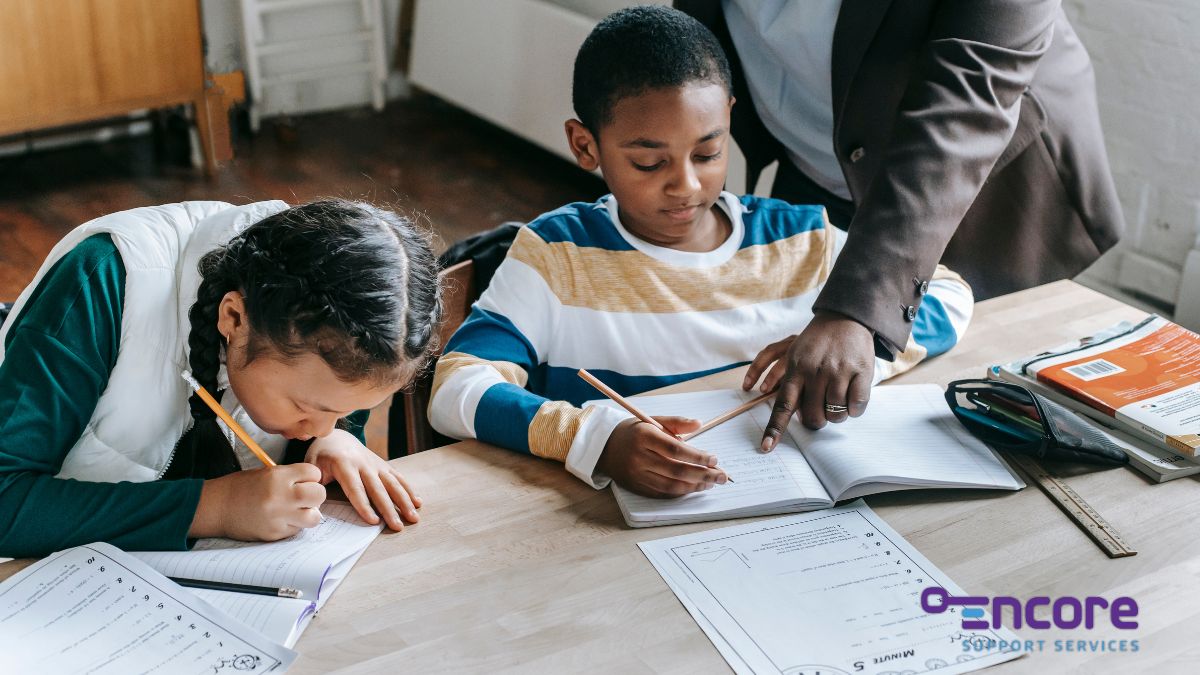
One of the most powerful aspects of Encore’s ABA programs is their collaboration with schools. Therapists often work side-by-side with teachers to adapt strategies to classroom needs.
Benefits for educators:
- • Teachers learn techniques to manage behavior positively.
- • Consistency between home, therapy, and school reduces confusion for the child.
- • Classmates benefit from awareness activities that encourage acceptance.
Creating a Team Approach
When parents, teachers, and therapists work together, children receive consistent support. This team model ensures skills practiced in therapy are carried into real learning environments.
 8. Research-Backed Impact of ABA on Academic Success
Evidence continues to show that ABA supports both academic and social development.
- • A 2024 review in the Review Journal of Autism and Developmental Disorders critically examined how quality of life and well-being in autistic people are measured. The authors emphasized the need for more inclusive and autism-centered approaches.
- • A 2024 scoping review highlighted that caregiver training supports the use of behavioral strategies in natural environments, fostering meaningful change in daily routines.
- • Studies also show early ABA intervention increases long-term adaptive skills, making transitions into middle and high school smoother.
By building communication, focus, and independence, ABA gives children the foundation they need for long-term academic success.
9. Addressing Parent Concerns
Parents often worry that their child will be left behind academically or socially. ABA programs provide reassurance by showing progress in measurable steps.
Common concerns addressed through ABA:
- • “My child can’t sit through circle time.” → ABA gradually increases sitting tolerance.
- • “My child doesn’t know how to make friends.” → ABA teaches structured ways to initiate play.
- • “My child melts down when routines change.” → ABA provides coping strategies and transition supports.
By addressing these challenges early, families set their children up for smoother school experiences.
Take the Next Step With ABA Support
Academic success for children with autism requires more than mastering subjects. It involves communication, independence, social participation, and emotional regulation. ABA therapy addresses these areas in practical, evidence-based ways, making classrooms more accessible and learning more enjoyable.
Every child deserves tools that help them succeed in school and beyond. By engaging in autism support services in New Jersey and New York, families can provide children with structured support that strengthens academic readiness, improves communication, and encourages independence.
Encore ABA is dedicated to preparing children for both the classroom and life outside of it. Reach out today to learn how ABA therapy can help your child grow, connect, and thrive in their academic journey.
Recent Questions
- Will my child ever be perceived as “normal”?
- How do I deal with an intensely emotional child, while juggling daily dut...
- How can I foster the development of early reading skills in my young childr...
- How can I help my child make friends?
- How do I make my home environment a happy, safe place for my child?
Encore Services
Special Ed
●
Behavior Modification DIR/Floortime
●
Social Skills & Social Thinking
●
Speech-Language Therapies
●
Multi-Sensory Math & Reading Instruction
●
Brain Gym & Physio-neurotherapy
●
Hebrew Reading Skill (Kriah) Training
●
Hands-On Music Therapy
●
Neuropsychological, Nutritional & Behavioral Evaluations
Encore ABA
●
Behavior Modification DIR/Floortime
●
Social Skills & Social Thinkin
g●
Speech-Language Therapies
●
Multi-Sensory Math & Reading Instruction
●
Brain Gym & Physio-neurotherapy
●
Hebrew Reading Skill (Kriah) Training
●
Hands-On Music Therapy
●
Neuropsychological, Nutritional & Behavioral Evaluations
